
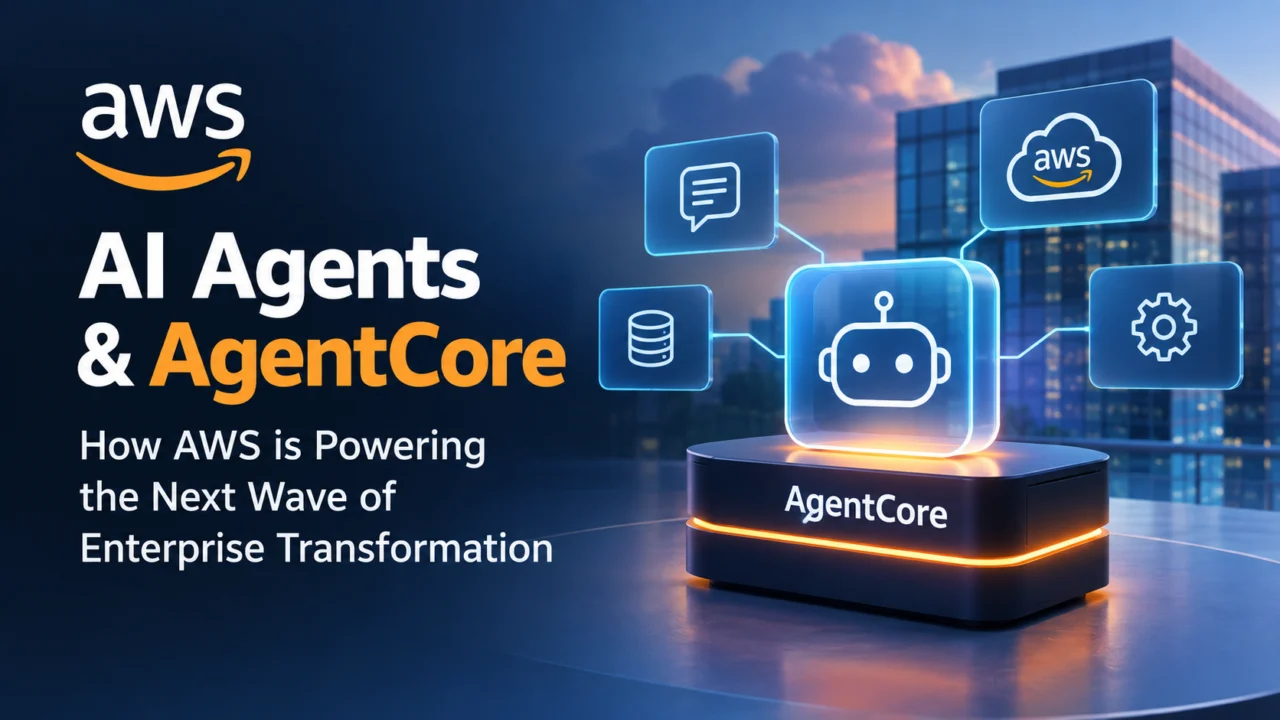
“This is the most impactful change since the dawn of the Internet” – AWS Leadership on the AI Agent Revolution
🚀 The Dawn of Intelligent Automation
Enterprise computing stands at an unprecedented inflection point. AI agents are fundamentally reshaping how businesses operate, moving beyond simple automation to intelligent, context-aware systems that can reason, learn, and adapt.
Amazon Web Services (AWS) has positioned itself at the forefront of this transformation with AgentCore, a comprehensive platform designed to build, deploy, and govern enterprise AI agents at scale. This isn’t just another cloud service—it’s a complete reimagining of how intelligent systems integrate into business workflows.
AWS AI Investment Highlights
📈 17% AWS Growth (Q2 2025) | 💰 $8 Billion AI Investment | 🤝 Strategic Anthropic Partnership | 🔧 Custom AI Chips (Trainium, Inferentia)
🛠️ AgentCore: Architecture for the Future
AgentCore represents a paradigm shift from traditional software architectures to agent-centric computing. Rather than building monolithic applications, organizations can now construct networks of specialized AI agents that collaborate to solve complex business challenges.
Core Components Breakdown
| Component | Primary Function |
|---|---|
| Runtime Engine | Scalable execution environment for AI agents with performance optimization |
| Memory Systems | Persistent context management and intelligent historical data retention |
| Orchestration Layer | Seamless coordination of multi-agent workflows and task delegation |
| Identity Framework | Fine-grained access control, role management, and security protocols |
| Knowledge Integration | Native connectivity to enterprise data sources and knowledge bases |
Ecosystem Enhancements
The AgentCore platform extends beyond core components with a rich ecosystem of supporting tools:
- AWS Marketplace for AI Agents – Pre-built agent solutions for common business scenarios
- S3 Vector Storage – Advanced vectorization capabilities for Retrieval-Augmented Generation (RAG)
- Governance Suite – Comprehensive tools for monitoring, auditing, and compliance management
See also : Comet perplexity: revolutionary agentic ai browser 2025
💼 Business Impact: From Promise to Performance
The transition to agent-based computing delivers measurable business outcomes across multiple dimensions. Organizations implementing AI agents report significant improvements in operational efficiency, decision-making speed, and employee productivity.
Transformative Business Applications
- Process Automation Excellence
Intelligent automation of complex workflows spanning HR operations, financial processes, customer service interactions, and regulatory compliance tasks. - Intelligent Assistant Development
Creation of specialized AI assistants that understand business context, company policies, and industry regulations to provide expert-level guidance. - Productivity Amplification
Substantial reduction in manual tasks (typically 40-60%) while maintaining security controls and operational oversight through sophisticated identity management. - Secure Data Integration
Private enterprise data integration through S3 Vector storage, enabling AI capabilities without compromising sensitive information.
🎯 Industry Applications and Use Cases
Different sectors are experiencing unique benefits from AI agent implementation:
Financial Services
Risk analysis automation, regulatory compliance monitoring, fraud detection systems, and customer service enhancement through intelligent agents that understand complex financial regulations.
Healthcare Systems
Clinical decision support, administrative workflow optimization, patient data management, and diagnostic assistance through AI agents trained on medical knowledge bases.
Manufacturing Operations
Predictive maintenance scheduling, supply chain optimization, quality control automation, and production planning through agents that monitor equipment and market conditions.
Professional Services
Document analysis, client communication management, project coordination, and knowledge management through specialized agents that understand professional workflows.
🔮 The Competitive Landscape
AWS isn’t alone in recognizing the transformative potential of AI agents. The entire cloud computing landscape is rapidly evolving, with major players making substantial investments in AI infrastructure and capabilities.
This competitive dynamic accelerates innovation while providing enterprises with multiple viable options for AI agent implementation. The key differentiator lies not just in raw computational power, but in the sophistication of governance tools, security frameworks, and integration capabilities.
🚀 Implementation Strategy: Getting Started
Successful AI agent adoption requires a strategic approach that balances ambition with practical execution:
Assessment Phase
Identify workflows suitable for agent automation, evaluate technical requirements, and assess organizational readiness for AI-driven processes.
Pilot Development
Begin with focused use cases that demonstrate clear value while building internal expertise and confidence in agent-based solutions.
Governance Framework
Establish policies for AI agent behavior, data access, and decision-making authority that align with corporate culture and regulatory requirements.
Scale and Optimize
Gradually expand agent deployment across additional workflows while continuously optimizing performance and measuring business impact.
⚡ The Urgency of Action
The window for gaining competitive advantage through AI agents is narrowing rapidly. Organizations that delay implementation risk falling behind competitors who are already leveraging these technologies to improve efficiency, reduce costs, and enhance customer experiences.
Early adopters are establishing significant operational advantages that will become increasingly difficult for laggards to overcome. The question is no longer whether to implement AI agents, but how quickly and effectively an organization can integrate them into core business processes.
🎊 Conclusion: Embracing the Agent-Driven Future
AWS AgentCore represents more than a technological advancement—it’s a blueprint for the future of enterprise computing. Organizations that embrace this shift toward agent-centric architectures position themselves to thrive in an increasingly competitive and rapidly evolving business environment.
The combination of powerful AI capabilities, robust governance tools, and scalable infrastructure creates unprecedented opportunities for business transformation. The companies that recognize and act on this opportunity today will define the competitive landscape of tomorrow.
Sources and References: