
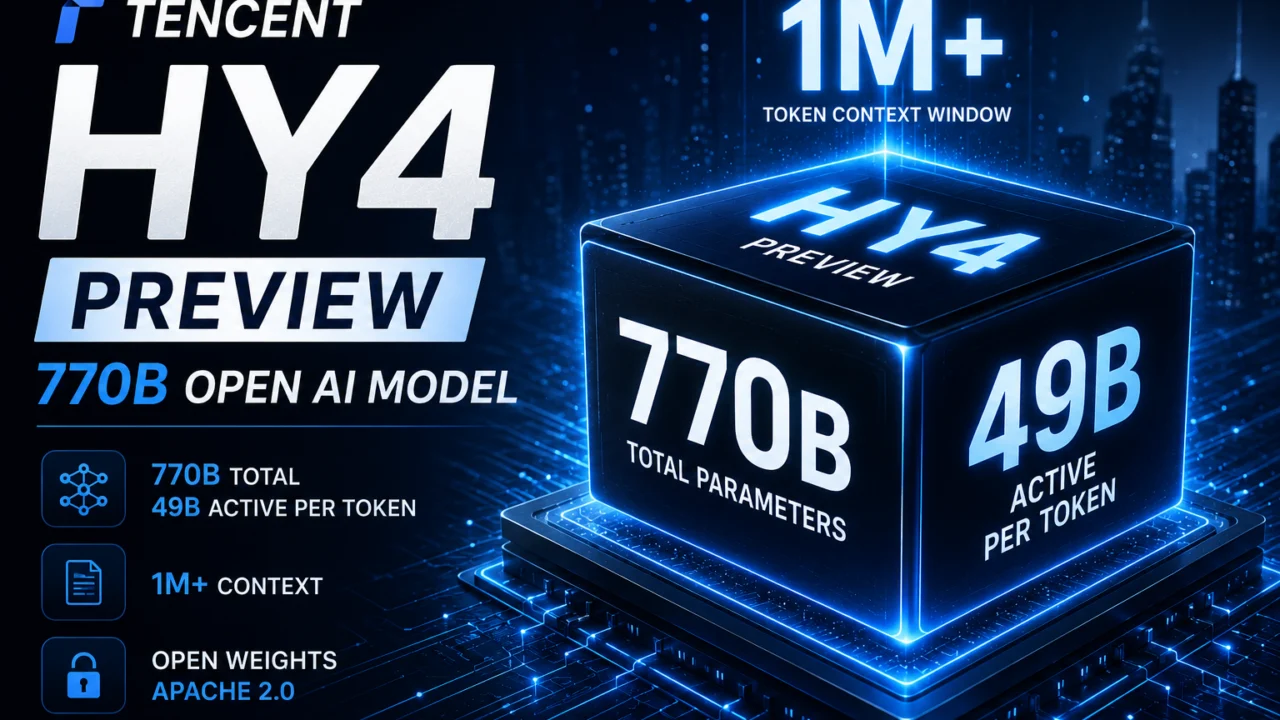
Tencent has released Hy4 Preview, a new flagship large language model aimed at demanding productivity tasks including software development, document analysis, financial work and scientific research.
The headline figure is difficult to ignore: 770 billion parameters.
But Hy4 Preview does not use all of them every time it generates a token. Thanks to a Mixture-of-Experts (MoE) architecture, only around 49 billion parameters are activated per token.
That distinction matters.
Instead of increasing computing requirements at exactly the same rate as the total size of the model, Tencent can provide access to a much larger pool of specialized parameters while activating only a fraction of them for each token.
Hy4 Preview also offers a context window exceeding one million tokens, open model weights under the Apache 2.0 license, and API pricing designed to make large-scale inference relatively affordable.
So what exactly has Tencent built — and why could Hy4 Preview matter in the increasingly competitive market for open AI models?
What Is Tencent Hy4 Preview?
Tencent officially unveiled and open-sourced Hy4 Preview on August 28, 2026.
The model was developed by the Tencent Hy Team and is positioned primarily around real-world productivity rather than conventional chatbot use.
Its main specifications include:
| Specification | Hy4 Preview |
|---|---|
| Architecture | Mixture-of-Experts (MoE) |
| Total backbone parameters | 770B |
| Activated parameters per token | 49B |
| Layers | 78 |
| Routed experts | 256 |
| Shared experts | 1 |
| Routed experts activated per token | 8 |
| Context length | 1M+ tokens |
| Attention architecture | Gated DeepSeek Sparse Attention |
| Native MTP layer | 10B total / 0.7B active |
| License | Apache 2.0 |
Hy4 Preview can be accessed through Tencent products including WorkBuddy and CodeBuddy, as well as through APIs such as Tencent Cloud TokenHub and OpenRouter.
The model weights and technical resources have also been released publicly.
But its 770-billion-parameter headline only tells part of the story.
770 Billion Parameters Does Not Mean 770 Billion Are Used Every Time
Traditional dense language models effectively rely on their entire network when processing each token.
A Mixture-of-Experts model works differently.
Instead of sending every token through all available parameters, the model contains multiple specialized neural networks known as experts.
A routing mechanism determines which experts should process each token.
Hy4 Preview contains 256 routed experts and one shared expert in each of its MoE layers.
For every token, the system activates only the top eight routed experts, together with the shared expert.
As a result, the complete backbone contains 770 billion parameters, while only around 49 billion are active for an individual token.
A simplified way to understand the architecture is this:
Hy4 has access to an enormous pool of specialized capabilities, but only calls on a relatively small subset of them for each piece of information it processes.
That can provide much greater total model capacity without requiring computation equivalent to a dense 770B model for every generated token.
This distinction between total parameters and active parameters is becoming increasingly important as AI developers look for ways to scale models without making inference costs grow at the same pace.
There Is Also a Separate 10B MTP Layer
The 770B figure refers specifically to Hy4 Preview’s main backbone.
Tencent has also included a native Multi-Token Prediction, or MTP, layer containing another 10 billion total parameters, of which approximately 0.7 billion are activated.
This component supports speculative decoding.
Instead of treating the generation of every future token as a completely separate operation, speculative decoding can attempt to anticipate several likely tokens and verify them more efficiently.
The objective is simple: generate responses faster without requiring the full model to perform the same amount of work at every step.
This additional component also explains why technical representations of Hy4 may occasionally show a parameter count slightly above the headline 770B figure.
For normal comparisons, however, Tencent itself describes Hy4 Preview as a 770B model with 49B active parameters.
A Context Window Beyond One Million Tokens
Hy4 Preview also supports a context length exceeding one million tokens.
That gives the model enough theoretical working space to process very large collections of information within the same session.
Potential workloads include:
- large software repositories;
- multiple technical documents;
- financial reports and spreadsheets;
- extensive research material;
- long project histories;
- cross-document analysis.
Tencent is explicitly targeting these types of workloads.
The company says Hy4 Preview was developed for long-horizon software engineering, financial analysis, office productivity, game development and scientific research.
A million-token context window does not automatically guarantee that a model will understand every detail contained within such a large input.
Long-context performance still depends on factors including retrieval accuracy, attention mechanisms and the model’s ability to identify relevant information among large amounts of less important content.
Nevertheless, large context windows are becoming particularly valuable as AI models evolve from simple chat interfaces toward systems expected to work across entire projects.
Hy4 Is Designed Around Productivity, Not Just Chat
Tencent’s positioning of Hy4 Preview is particularly revealing.
The company is not primarily presenting Hy4 as another conversational assistant.
Instead, it emphasizes work.
Tencent says it collaborated with internal software engineers, game developers, financial analysts, security specialists and other experts to build training data around tasks they encounter in real professional environments.
The model is intended to work with information spread across multiple sources and transform it into useful outputs such as:
- software;
- documents;
- spreadsheets;
- presentations;
- financial analyses;
- research results.
In software engineering, Tencent says Hy4 has improved its ability to understand, plan, debug and verify long-running development tasks.
For office and analytical workloads, it is designed to combine information from multiple files and produce structured deliverables.
This reflects a broader change across the AI industry.
The competition between advanced models is increasingly moving away from simply answering questions and toward completing multi-stage workflows.
Coding assistants are one of the clearest examples, but similar systems are emerging for research, financial analysis, document creation and many other professional tasks.
Tencent Says Hy4 Competes With GLM and Kimi
Tencent has also published comparisons with other major Chinese AI models.
In an internal blind evaluation, 163 Tencent experts evaluated model outputs across 203 engineering tasks.
According to Tencent, the average scores were:
- Hy4 Preview: 2.99 / 4
- GLM-5.3: 2.92 / 4
- Kimi K3: 2.94 / 4
Tencent also reports that Hy4 Preview won 46.8% of pairwise evaluations against GLM-5.3, with 12.8% ties.
Against Kimi K3, Tencent reports a 51.2% win rate, with 7.9% ties.
Those results are notable, but they require an important qualification:
the evaluation was conducted internally by Tencent.
They should therefore not be interpreted as independent proof that Hy4 Preview is universally superior to GLM-5.3 or Kimi K3.
Benchmark results can change significantly depending on the tasks being evaluated, prompts, tool configurations, reasoning settings and agent frameworks.
Independent testing will be essential to determine how Hy4 performs outside Tencent’s own evaluation environment.
Hy4 Preview Helped Optimize Its Own Infrastructure
One of the more unusual parts of Tencent’s announcement concerns the role Hy4 Preview played during its own development.
Tencent says the model participated in parts of the engineering process, including the automated optimization of training methods, data strategies, evaluation frameworks and low-level operators.
The company also says Hy4 analyzed bottlenecks in its inference infrastructure and iterated on optimizations including operator fusion and communication efficiency.
According to Tencent, those improvements increased end-to-end throughput by 31.8% compared with its baseline.
This does not mean that Hy4 independently designed and trained its successor without human involvement.
The work still takes place within systems, experiments and objectives created by human engineers.
But it demonstrates an important emerging trend.
Advanced AI models are increasingly capable of helping researchers and engineers improve the infrastructure used to train and run other AI systems.
That could gradually shorten the feedback loop between AI development and AI-assisted AI development.
How Much Does Hy4 Preview Cost?
Tencent is also competing aggressively on API pricing.
At launch, the company lists the following prices:
| Usage | Price per 1M tokens |
|---|---|
| Input | $0.834 |
| Cached input | $0.042 |
| Output | $2.501 |
These figures make cost an important part of Hy4’s positioning.
Demystia has previously examined how quickly price differences can become significant in our DeepSeek vs GPT API comparison, particularly when applications process large volumes of tokens.
This issue becomes even more important with agentic workloads.
A conventional chatbot might exchange a few messages with a user.
An AI agent can repeatedly read documents, inspect code, call tools, analyze results and generate new reasoning steps before completing a task.
That can multiply token consumption dramatically.
A model’s intelligence is therefore only one part of its real-world value.
Cost per useful completed task is becoming an increasingly important metric.
Latency, reliability, reasoning efficiency and tool use can matter just as much as benchmark scores.
Open Weights Could Be Just as Important as the Benchmarks
Hy4 Preview has been released under the Apache 2.0 license.
Tencent’s official Hy4 Preview repository provides resources for deployment, fine-tuning and quantization, including support for frameworks such as vLLM and SGLang.
For developers and organizations, open weights offer greater control over how a model is deployed, adapted and integrated into existing infrastructure.
But there is an important limitation.
A Mixture-of-Experts architecture reduces the number of parameters actively involved in processing each token, but it does not make the complete model small.
The full weights still represent an enormous model.
Running Hy4 Preview locally is therefore very different from deploying a much smaller open model on a consumer GPU.
As Demystia explored in our guide to installing DeepSeek on your own server, local AI deployment requires careful consideration of GPU memory, system RAM, storage, quantization and inference infrastructure.
Those constraints become substantially more demanding at Hy4’s scale.
In other words:
49B active parameters does not mean Hy4 only requires the hardware needed to store a 49B model.
Its MoE architecture reduces inference computation, but deploying the complete model still requires infrastructure capable of handling its hundreds of billions of stored parameters.
Hy4 Preview is therefore primarily relevant to substantial server or datacenter deployments rather than ordinary desktop PCs.
Another Sign of the Rise of Chinese Open AI Models
Hy4 Preview matters beyond Tencent itself.
Chinese AI developers have become increasingly influential in the global open-model ecosystem.
DeepSeek, GLM and Kimi have all contributed to a market in which developers increasingly have alternatives to proprietary models from companies such as OpenAI, Anthropic and Google.
Tencent is now trying to establish Hy4 firmly within that group.
The architecture itself reflects how quickly ideas circulate through this ecosystem.
Tencent says Hy4’s attention system uses Gated DeepSeek Sparse Attention, building partly on approaches associated with DeepSeek and GLM.
Rather than every AI company developing completely isolated architectures, successful techniques are increasingly being adapted and extended by competing research teams.
Open models accelerate that process because developers can inspect, test and build on publicly available systems.
For readers following this rapidly evolving ecosystem, Demystia’s DeepSeek coverage provides another example of how Chinese AI models have moved from regional competitors to globally relevant technologies.
Hy4 Preview Is Still a Preview
The model’s name is important.
This is Hy4 Preview, not the final Hy4 release.
Tencent openly acknowledges several known limitations.
According to the development team, the current model can sometimes spend longer than necessary reasoning through complex tasks and has a tendency to over-verify its own work.
That may sound relatively minor, but it can become important in agentic applications.
A model that repeatedly reasons, checks and rechecks its work can consume substantially more tokens and increase response latency.
That can reduce some of the economic advantages offered by low API prices.
Efficiency is therefore not only about the number of parameters activated per token.
It is also about how many tokens the model needs to complete a task successfully.
Tencent says it is using the preview release to gather real-world feedback, and additional models in the Hy4 family are expected to follow.
Why Tencent Hy4 Preview Matters
The easiest way to describe Hy4 Preview is as a 770-billion-parameter open AI model.
But that headline misses the most interesting part.
Hy4’s significance lies in how those parameters are organized.
By combining a huge pool of experts with only 49 billion active parameters per token, Tencent is attempting to expand model capacity without making the computational cost of every generated token increase at the same rate.
Add a context window beyond one million tokens, competitive API pricing, open weights and a strong focus on real-world professional workloads, and Hy4 Preview becomes more than another large number on a model specification sheet.
It illustrates three major trends happening simultaneously in artificial intelligence:
- Mixture-of-Experts architectures are allowing models to grow without activating every parameter for every token.
- Open models from Chinese AI companies are becoming increasingly important internationally.
- The competition is shifting from chatbot performance toward models capable of completing useful, multi-step work.
Tencent’s internal results suggest that Hy4 Preview can compete with some of the strongest open models currently available.
But those results remain Tencent’s own evaluations.
The next step will be independent testing.
If Hy4 can combine strong real-world performance with its comparatively low inference pricing, the most important number may ultimately not be its 770 billion parameters.
It may be how much useful work those 49 billion active parameters can actually accomplish.
Sources
- Tencent — Official Hy4 Preview announcement, August 28, 2026
- Tencent Hy Team — Hy4 Preview official repository and technical documentation
- Reuters — Independent coverage of the Hy4 Preview launch, August 28, 2026