
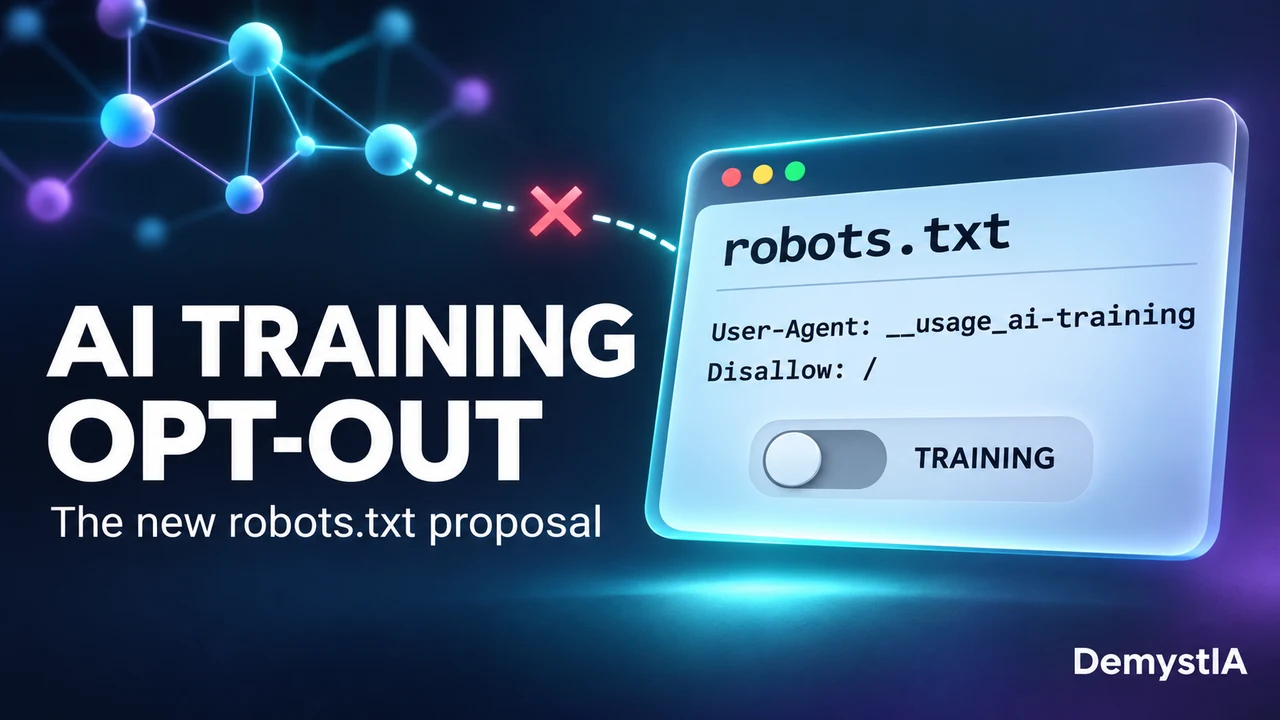
Google, Microsoft and OpenAI announced support for a shared AI training preference on October 30, 2026. The proposal would let website owners communicate one choice to participating providers through their robots.txt file, reducing the need to maintain a separate instruction for each company.
For publishers, the practical benefit is simpler administration. However, announced support does not mean the control is already operational everywhere, and refusing training can have different consequences depending on the provider.
Here is what the proposed signal does, when support is planned, and what website owners should check before changing their settings.
Information checked on November 2, 2026.
What the shared signal actually does
The mechanism uses a policy token called __usage_ai-training. It fits into the existing structure of robots.txt, with familiar Allow and Disallow rules.
A site-wide training refusal would look like this:
User-Agent: __usage_ai-training
Disallow: /
Under the proposal, this expresses a preference against using the site’s content to train generative AI models. Here, training means changing a model’s learned parameters.
The token communicates a usage preference; it is not itself an instruction to stop crawling. The technical proposal remains an individual Internet-Draft, rather than an approved IETF standard.
When providers plan to support it
Implementation dates matter because adding a setting today does not establish that every provider is already applying it.
| Provider | Announced timing | Important detail |
|---|---|---|
| Early 2027, according to its crawler documentation | Plans to map the shared refusal to Google-Extended when that token is not explicitly specified | |
| Microsoft | February 1, 2027, as content is crawled | Separates training preferences from grounding preferences |
| OpenAI | In the coming months | Says its existing crawler controls will continue to apply |
Google’s documentation, Microsoft’s implementation guide and OpenAI’s announcement describe these timelines.
OpenAI frames the initiative as a voluntary way to simplify publishers’ choices across participating providers. It also says it will provide further implementation details. Existing controls therefore remain relevant during the transition.
Training and answering are different uses
A publisher might want an assistant to cite a tutorial while refusing to let that tutorial become material for future model training.
Those are separate objectives:
- Training changes a model’s learned parameters.
- Grounding supplies information when an AI system prepares an answer.
- Search indexing makes pages eligible for retrieval in a search service.
Microsoft’s announced controls distinguish training from grounding. Its guide describes a configuration that refuses training while allowing content to inform generated answers. These preferences do not change eligibility for traditional Bing results, subject to the normal crawling and indexing requirements.
The commercial question is whether a publisher wants visibility through AI answers, permission for model development, or both. A single decision labelled “block AI” can obscure those different goals.
Why Google requires a closer look
Google’s announcement says that a shared training refusal will be treated like a Google-Extended refusal when the site does not explicitly specify Google-Extended.
That matters because Google-Extended governs both training future Gemini models and grounding in Gemini Apps and the relevant Vertex AI service. Google says this token does not affect inclusion or ranking in Google Search.
Website owners should therefore check the Gemini consequences of their configuration before assuming a training refusal leaves every AI discovery channel unchanged. Google also says company-specific controls will continue alongside the shared signal.
A useful way to evaluate the proposal is to separate the common vocabulary from each provider’s implementation. A shared setting can reduce maintenance while still requiring product-specific decisions.
What website owners should do now
For a blog, specialist publication or business website, a sensible preparation process is:
- Define the intended use policy. Decide separately whether model training and inclusion in AI answers serve the site’s goals.
- Audit existing rules. Record the crawler-specific instructions already present and check for conflicting settings.
- Keep current controls during the rollout. Review provider documentation before replacing working rules with the shared token.
- Check the delivered file. After a CMS or SEO plugin change, inspect the public
robots.txtoutput and preserve unrelated instructions.
Microsoft adds a specific transition for sites using NoArchive or NoCache as training or grounding preferences. Its guide sets March 1, 2027 as the migration deadline and includes additional steps for preserving grounding restrictions. Administrators relying on those controls should follow the full guide rather than substitute a single robots.txt block.
For a small publisher, the immediate task is to make the site’s choices explicit and maintainable. A documented policy is easier to review than a growing collection of bot names copied from unrelated tutorials.
The limits of a shared preference
The proposal does not create a technical access barrier. It separates usage preferences from crawler rules, and it allows for more specific provider controls and private agreements to affect interpretation.
It should not be presented as a tool for removing information already learned by a model. Nor does its publication establish universal adoption.
From an editorial perspective, the strongest benefit is reduced administrative friction. The unresolved test is whether publishers can understand the consequences of their choice and verify how participating providers apply it.
For now, website owners can prepare for a simpler shared training preference while retaining the provider-specific settings needed to express their actual goals.
Sources
- IETF Datatracker — Machine-Readable Training Preference Signal, individual Internet-Draft published October 30, 2026.
- Google Search Central — Supporting a shared AI training control for websites, October 30, 2026.
- Google documentation — Common crawlers and Google-Extended.
- Microsoft Bing — Your content, your choice, announcement and implementation guide.
- OpenAI — Making it easier for websites to express AI training preferences, October 30, 2026.