
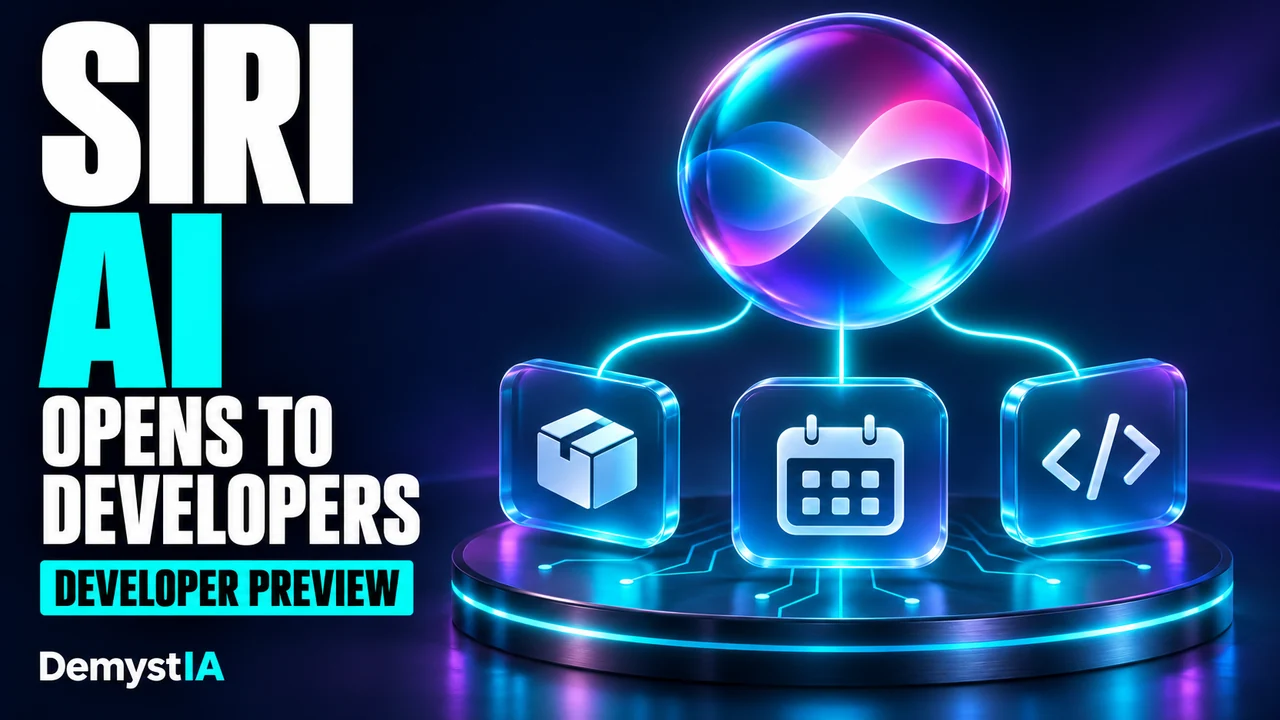
Apple is opening a new route for apps to work through Siri AI. On November 3, 2026, it announced a Developer Preview that lets developers expose custom app content and actions to the assistant. The opportunity is to complete useful tasks through conversation, with each app providing the functions Siri can call. Apple’s announcement
For users, this could mean fewer steps between asking a question and getting something done. For developers, it creates another way for people to use their product. The immediate release is a preview for development and testing, however, so the distinction between a demonstrated integration and a shipping feature matters.
What Apple has opened
The preview arrives in the iOS 27.3, iPadOS 27.3, macOS 27.3 and visionOS 27.3 betas. Apple says customer availability is expected in a few months, with App Store submissions opening in the spring. It has yet to provide full terms and usage policies for these experiences. Launch details
Developers therefore have an opportunity to experiment before deciding how much of their product to build around this interface. A successful prototype can establish that a particular action works; it does not establish that every customer can use it today.
Apps provide the actions Siri can use
App Intents is Apple’s framework for describing an app’s capabilities and content to the system. An intent represents an action; an entity represents something the app manages, such as a message or an event. Apple explained these foundations in its WWDC26 session on Siri integration.
The new preview extends Siri’s reach to custom actions and content beyond the system’s predefined schema domains. Apple explicitly says Siri can use only the custom content and actions an app makes available through App Intents. Developer Preview documentation
That boundary is useful for understanding the announcement. An app developer is defining a set of usable operations. A conversational request becomes valuable when the system can identify the relevant information, choose an appropriate operation and return a result the user understands.
For example, a hypothetical delivery app might expose an order-status query. Supporting an address change would require a separate operation, with its own validation. Understanding the words “change my address” does not itself make that operation available.
Context could make requests more natural
Apple’s documentation describes situations where people can omit the app’s name: when it is in the foreground, has an active Live Activity, or is already part of the conversation in the Siri app. For a background app, the documented custom-action scenario requires naming it. Preview documentation
This could make a practical difference to everyday interaction. When looking at a particular item, a person may naturally refer to “this” rather than repeat its full name. A useful assistant needs to connect that reference to the correct object.
Apple’s WWDC explanation shows how developers associate visible content with structured entities to support onscreen awareness. This depends on how the app describes its interface and data. Technical explanation
For a product team, the design question is how to make the intended object clear when several possibilities exist. A voice interface should have an understandable way to resolve that ambiguity before changing anything.
Combining actions creates a bigger design task
The preview also introduces app skills that guide Siri through complex tasks involving several tool intents. Developer documentation
A single request can hide several decisions. Consider a hypothetical booking flow: find available times, identify the preferred service, select a slot and confirm a reservation. Each step needs a valid result before the next can succeed.
Our recommendation is to start with a task whose outcome is easy to inspect. Looking up an existing booking is a useful early test because the answer can be compared with the app’s own record. Creating or changing a booking introduces additional questions about confirmation, conflicts and recovery.
The same distinction appears in our guide to AI agent permissions for emails, files and purchases: permission to find information and permission to make a commitment should be considered separately.
Availability remains a major qualification
Apple says Siri AI requires an Apple Intelligence-enabled device and a supported language. Its current announcement states that Siri AI is unavailable in the European Union on iOS, iPadOS and watchOS. French language support therefore should not be mistaken for availability on an iPhone in France. Availability notes
For a business serving several countries, regional access belongs near the beginning of the evaluation. Before promising a new customer journey, establish which users can actually reach it.
The preview documentation also limits testing to development builds and internal TestFlight testers. Its custom integration functionality is unavailable to external TestFlight testers and App Store-distributed versions during the preview. Testing restrictions
That makes this a period for controlled trials and feedback. Customer-facing announcements should distinguish what has been built internally from what people can install and use.
What developers should evaluate first
A useful pilot would expose one clear action and test the complete interaction, rather than only a successful demonstration.
| Test case | What the team should check |
|---|---|
| A clear request | The intended action runs and returns an accurate result |
| An ambiguous item or contact | The user can resolve the ambiguity |
| Missing information | The interaction asks for what is needed |
| An expired session or failed connection | The app gives a recoverable result |
| A repeated request | The workflow avoids an unintended duplicate commitment |
These are suggested evaluation cases, not claims about how Siri already handles every situation.
Our reading of the announcement is that app integration could become an important part of product design. If people increasingly request outcomes through an assistant, the quality of an app’s exposed actions may matter alongside its screens.
The most useful first step is to make one operation clear, reliable and easy to verify. Our introduction to what you can actually delegate to AI agents offers a broader framework for choosing that task.
Sources
- Apple Developer — Siri AI is now open to all developers, November 3, 2026.
- Apple Developer — Siri AI Developer Preview, consulted November 4, 2026.
- Apple Developer — Build intelligent Siri experiences with App Schemas, WWDC26.