
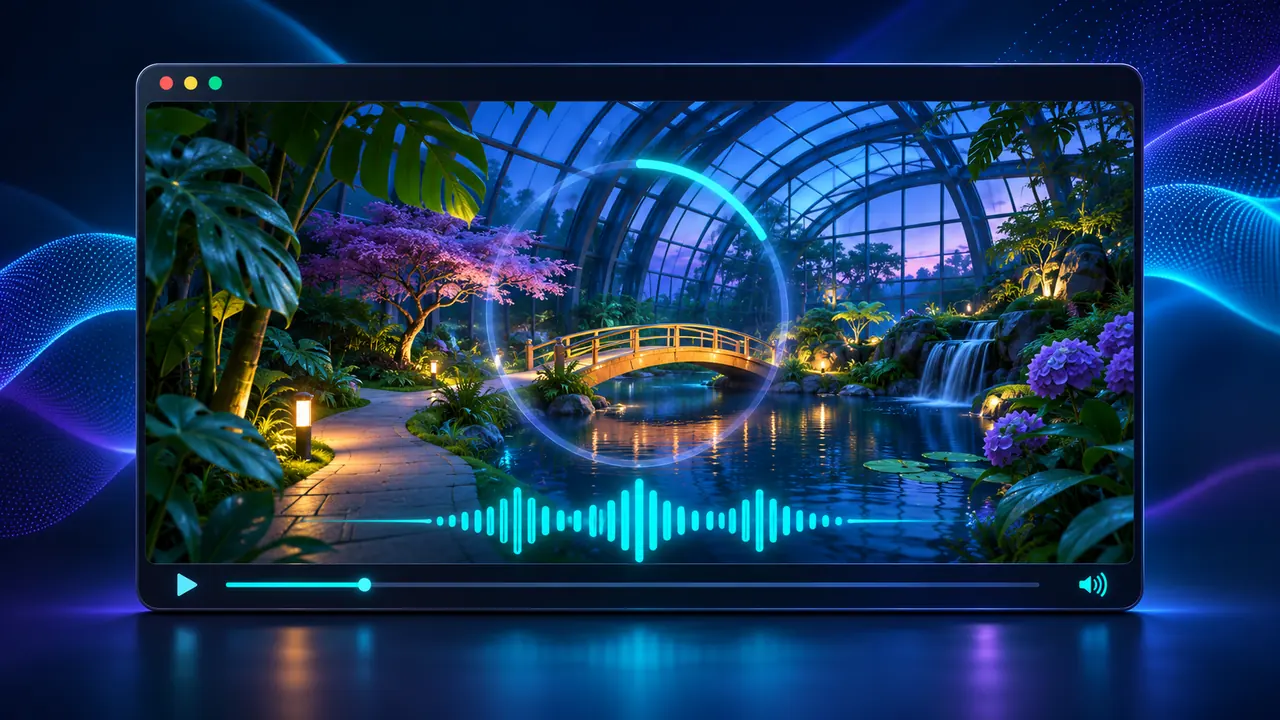
A visitor opens an interactive garden in a browser, crosses a footbridge and changes the lighting with a text prompt. Forty-five seconds of generated video and audio would cost about $4.54 at Google’s standard Genie 4 API rate. If the visitor closes the tab, the server can keep generating frames and billing until the interaction ends.
Google brought Genie 4 to the Gemini API and Google AI Studio on November 19, 2026, a day after rolling it out in Project Genie for eligible Google AI Ultra subscribers. The API lets developers build the controls, access rules and session limits into their own applications. Developer access requires a paid Gemini API key. Google’s API launch announcement
What the API sends to the browser
An application starts a world with a text description, a reference image or both. After the world starts, the browser sends movement controls and text instructions over a live connection. Genie 4 generates the next frames and their corresponding audio as the scene evolves. The API’s published output is 720p at 24 frames per second, with synchronized stereo audio. For browser applications, Google’s integration guide recommends WebRTC and shows how the application’s backend can issue a short-lived token for a specific interaction. Genie 4 integration guide
The initial image gives the model a starting point. In a garden demo, asking for twilight could help a design team assess the atmosphere under different lighting. The model may shift a landmark when the visitor turns away and returns. To evaluate repeatable routes, run the same sequence several times and check whether the turn, bridge and exit still line up. For background on how the model works, see Demystia’s introduction to Genie 4.
How to estimate Genie 4 API costs
Google bills the stream by generated video tokens. Each frame accounts for 240 tokens, so a 24 fps stream produces 5,760 tokens per second. At $17.50 per million video output tokens, that works out to $0.1008 per second, with audio included. Google lists separate charges for text and reference-image input and any text output. Gemini API pricing
| Generated stream | Estimated video and audio cost |
|---|---|
| 30 seconds | $3.02 |
| 45 seconds | $4.54 |
| 60 seconds | $6.05 |
| 120 seconds | $12.10 |
These estimates assume continuous generation at 24 fps. They cover the stream, excluding separately metered tokens and application costs. Google documents 120 seconds as the per-session maximum. Its model specification also notes that scene consistency tends to be stronger earlier in the session. Genie 4 model specification
For an internal pilot with 20 reviewers making two 30-second attempts each, budget $120.96 for generated video and audio. A demo with 1,000 visits averaging 45 generated seconds would cost $4,536 for the stream, using the unrounded rate. Repeated attempts and frames generated after a visitor leaves can increase the average.
Give the session an explicit end
Google documents a distinction between disconnecting the browser and completing the interaction. An End session button can call session.complete() and wait for the interaction.completed event. Closing a tab or detaching the connection can leave the server-side generation running. The API also supports session.cancel() to abort generation. Google’s session lifecycle documentation
For a public demo, enforce the intended duration in the application’s backend and track how each interaction ended. Test a normal exit, a tab close and a lost connection. Compare the time the visitor spent in the demo with the video tokens recorded for those cases. That comparison shows what to budget when visitors behave differently from the people who built the demo.
Sources
- Google’s Genie 4 API and AI Studio announcement, November 19, 2026
- Project Genie rollout announcement, November 18, 2026
- Genie 4 integration guide and model specification
- Gemini API standard pricing for Genie 4
Pricing checked on November 21, 2026. The cost examples are calculated from Google’s published rates.