
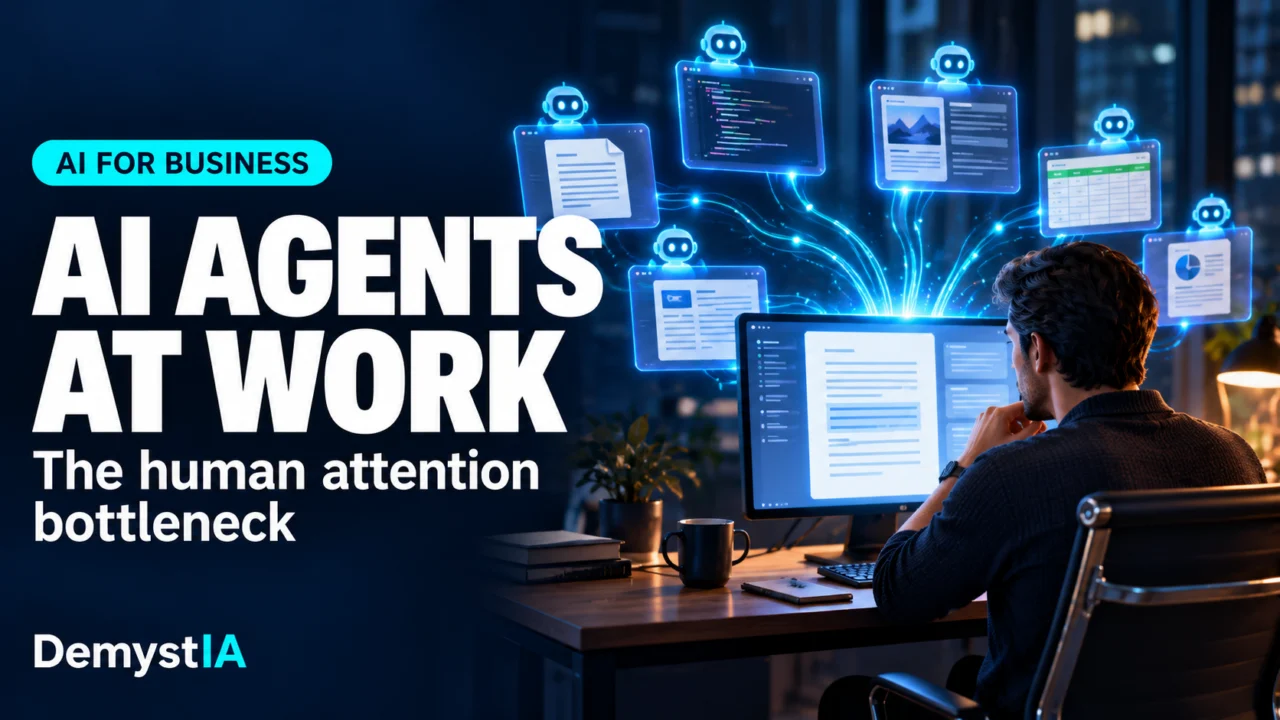
AI agents can make it easier to generate work than to review it. A study published by Anthropic on October 16, 2026, describes that tension inside its own organization.
The question for businesses is what happens after an agent finishes a task. Someone still needs to identify important findings, resolve uncertainty and decide which results are ready to use. Expanding automated production can make those responsibilities more demanding.
What Anthropic observed inside its teams
In its employment study, Anthropic reports that employee-directed interactive agents accumulated six times as many runtime hours as estimated human working hours by August 2026.
The comparison pools subagents and estimates human time using headcount and a 40-hour week. It measures activity, rather than a sixfold increase in useful output.
The company also estimates that reading all agent output would occupy more than half a working week even for non-technical groups. That estimate uses assumed reading speeds; it does not measure time employees actually spent reading.
The practical implication is a capacity mismatch: it is possible to commission more work than a person can examine carefully.
The work around the work
Consider an illustrative marketing team using agents to prepare customer research, compare competitors and draft campaign ideas simultaneously.
Each assignment may produce a plausible result. Taken together, the outputs might repeat the same evidence, use incompatible assumptions or suggest actions that compete for the same budget. Reviewing every document individually would miss some of those conflicts.
Our recommendation is to design the handoff before increasing the number of agents. A useful handoff identifies the decision being supported, the evidence needed to make it and the unresolved questions requiring a person’s attention.
For example, a competitor research agent could return three findings with source links, explain which finding could change a campaign decision and flag missing information. A long narrative would remain available when needed, while the decision summary would become the normal review surface.
This is an editorial workflow example. Its value would need to be tested against the team’s existing process.
Delegation depends on the ability to check results
An earlier Anthropic study, published in December 2025, surveyed 132 engineers and researchers and included 53 qualitative interviews.
Participants described favoring tasks whose correctness they could readily check, alongside routine or low-stakes work. Some also worried that less direct practice could weaken the technical knowledge needed to supervise AI.
That creates an important management question: how will employees maintain the expertise required to judge the work they delegate?
For an illustrative software team, generating a fix and assessing whether it belongs in a production system involve different responsibilities. The reviewer needs to understand the intended behavior, the tests and the surrounding constraints.
A delegation process should therefore preserve opportunities to investigate failures and explain decisions. Otherwise, a team could become increasingly dependent on outputs it finds harder to evaluate.
What the evidence can tell us about productivity
Anthropic’s October study uses internal records and interviews. Adoption of tools was not randomized, and the company acknowledges that selection into AI use can bias its estimates. Its experience offers a case study rather than a representative forecast for other employers.
Independent research illustrates why measuring productivity remains difficult. In a February 2026 update, METR explained that its follow-up developer experiment faced serious selection problems.
Some developers did not want to participate if they had to work without AI. Participants also withheld tasks they preferred to complete with AI. Concurrent agent use complicated measurements of time spent.
METR considered the resulting estimates unreliable as a measure of the current productivity effect. It believed improvements over early 2025 were likely, while emphasizing that its data provided weak evidence about their size.
These findings support a practical distinction between enthusiasm for a tool, observed activity and a measured improvement in completed work.
Measure the whole handoff
For a business trial, our recommendation is to track the path from assigning work to accepting a usable result.
| Measure | Question it helps answer |
|---|---|
| Accepted results | How much completed work meets the agreed standard? |
| Human review time | How much attention does each accepted result require? |
| Corrections and retries | Which problems repeatedly create extra work? |
| Time to completion | Does the full process finish sooner? |
| Running cost | What does an accepted result cost, including review? |
These are suggested evaluation measures, rather than results reported by the studies.
A team might discover that an agent produces drafts quickly but creates a growing review queue. Another workflow might deliver modest drafting gains while sharply reducing the time needed to find supporting evidence. Those outcomes would justify different deployment choices.
The evaluation should also preserve comparable quality requirements. Accepting less reliable work can make a process appear faster while moving its costs into later corrections.
Give human judgment a clear place in the workflow
A practical starting point is one recurring task with a defined completion standard. Specify what the agent should return, which uncertainties it should surface and who can accept the result.
DemystIA’s guide to permissions for AI agents handling emails, files and purchases explores the related question of which actions an agent should be allowed to perform.
Our reading of the evidence is that effective delegation depends partly on how well the surrounding organization turns outputs into decisions. Adding agents should serve a clear purpose: more useful work completed within the team’s ability to understand and manage it.
Sources
- Anthropic — How employment is changing at Anthropic, October 16, 2026. Internal employment and agent-use study.
- Anthropic — How AI is transforming work at Anthropic, December 2, 2025. Earlier employee survey and interviews.
- METR — We are Changing our Developer Productivity Experiment Design, February 24, 2026. Independent discussion of selection effects and measurement difficulties.