
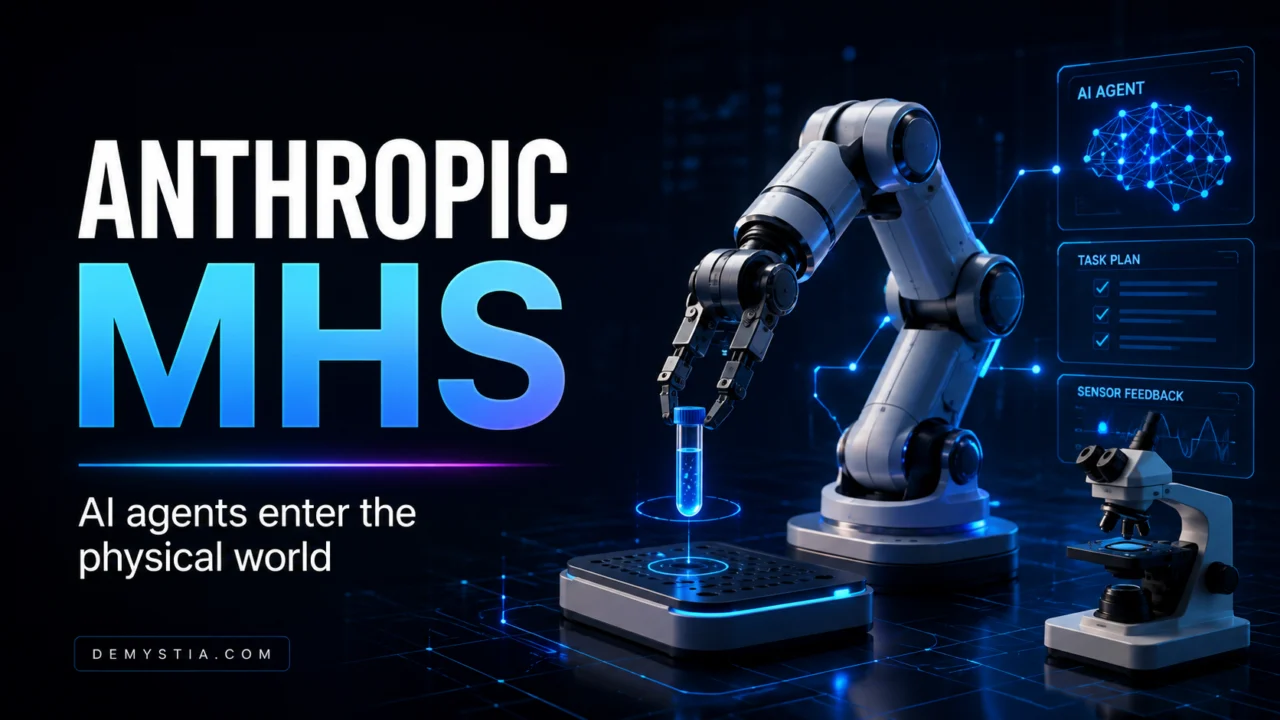
AI agents are becoming increasingly capable of using software, browsing the web and completing multi-step digital tasks. Anthropic now wants to extend that idea beyond the computer screen.
On August 27, 2026, the company introduced a research preview of the Model Hardware Standard (MHS), a framework designed to let AI agents interact with programmable physical equipment.
The target is not primarily consumer robots. Anthropic is initially focusing on scientific laboratories and advanced manufacturing, where an AI agent could potentially coordinate microscopes, robotic arms, liquid-handling systems or highly specialized research equipment.
The idea represents an important evolution for agentic AI.
Anthropic’s Model Context Protocol helped establish a common way for AI systems to interact with software and data. MHS attempts to extend a similar philosophy into the physical world.
And an early experiment with quantum-computing company QuEra provides a glimpse of what that could mean in practice.
What is the Model Hardware Standard?
The Model Hardware Standard is intended to provide a common interface between AI agents and physical devices.
Today, connecting intelligent software to laboratory or industrial equipment often requires custom integrations. Different machines expose different commands, protocols and control systems, forcing engineers to build software for each particular setup.
Anthropic wants MHS to provide a more standardized layer.
According to information released around the research preview, MHS can work with equipment that has a programmable interface and is designed to be model-agnostic. That means the concept is not restricted to Claude: other AI models and agent systems could theoretically use compatible hardware as well.
MHS can also connect several instruments as part of the same workflow.
That matters in a scientific laboratory, where an experiment may involve a chain of devices rather than a single machine.
An agent could, for example, operate an instrument, inspect the resulting measurement, change a parameter and then trigger another piece of equipment.
This creates something much closer to a closed experimental loop.
From MCP for software to MHS for machines
MHS can be understood more easily by comparing it with another Anthropic project: the Model Context Protocol, or MCP.
Anthropic introduced MCP in 2024 as an open standard for connecting AI applications with external data sources and software tools. An MCP-enabled agent might retrieve files, query a database or call an external service through a standardized interface.
MHS moves the concept one step further.
Instead of only giving an agent access to software tools, it creates a framework through which an agent can interact with physical tools.
The progression looks roughly like this:
LLM → software tools → AI agent → physical equipment
MHS can also make use of existing protocols such as MCP, meaning the two ideas are complementary rather than competing standards.
The difference, however, is significant.
Changing a spreadsheet is not the same as changing the operating parameters of a microscope or robotic system.
Once an AI agent can affect the physical world, reliability and safety become considerably more important.
Why laboratories are an obvious target
Modern research laboratories contain a surprising amount of programmable equipment.
Microscopes can move and focus automatically. Robotic liquid handlers can prepare samples. Sensors continuously collect measurements. Lasers can be controlled electronically. Manufacturing systems already rely heavily on software and automation.
The problem is often coordination.
Individual machines may be programmable, but connecting them into a flexible workflow can require specialist engineers and significant amounts of custom software.
Anthropic says MHS could reduce that integration work dramatically, potentially turning processes that currently take weeks or months into tasks completed in hours or minutes.
That claim has not yet been independently demonstrated across the wide range of hardware MHS is intended to support.
But the potential is important.
An AI agent capable of understanding an objective, configuring equipment, examining results and adjusting its approach could make some experiments far more autonomous.
Instead of automating only a predefined sequence, the system could potentially respond to what happens during the experiment.
QuEra offers an early real-world example
One of the most interesting demonstrations comes from QuEra Computing, which develops neutral-atom quantum computers.
These systems rely on extremely precise lasers to control atoms used as qubits.
Keeping those lasers correctly tuned is technically demanding. When a laser moves too far away from its desired operating point, an expert may need to diagnose the problem and restore it manually.
QuEra participated in the MHS research preview and gave Claude access to a dedicated test environment.
According to QuEra, the AI agent was allowed to experiment with the equipment, examine the results, refine its approach and eventually generate conventional control software for recovering the laser system.
Importantly, the final production system is not Claude continuously deciding how to control the laser.
The agent was used to develop and validate the controller, while the resulting program is conventional, inspectable software. Engineers also defined the operating scope and reviewed the process.
That distinction is important because it provides a more controlled example of how AI agents could interact with sensitive hardware.
695 successful recoveries out of 700 tests
QuEra reports striking results from its pilot.
The company says the resulting controller successfully returned the laser system to its target state in 695 out of 700 timed trials covering seven types of faults.
According to QuEra, the five unsuccessful tests were traced to a condition in the experimental rig rather than an incorrect success report by the controller.
Most faults were reportedly corrected in less than six seconds, while the most difficult took around 10 to 14 seconds.
QuEra compares that with roughly five to ten minutes for an expert operator.
The company also reports that the AI-generated configuration reduced residual noise by a factor of five in another optimization task.
Finally, when the system was moved to a second laser wavelength, QuEra says the agent found suitable settings during a single unattended overnight run — a task it says would normally require weeks of commissioning work.
These numbers are promising, but they should be interpreted carefully.
They come from QuEra, an MHS research-preview participant, rather than from an independent benchmark organization. They also relate to a specific system and should not be generalized to all laboratory or manufacturing hardware.
Even so, the experiment demonstrates something more concrete than a theoretical framework: an AI agent was used to explore a physical system, test possible solutions and produce control logic that was subsequently deployed.
AI could close the scientific loop
Large language models are already useful in research for activities such as reviewing scientific literature, analyzing data, writing code and generating hypotheses.
But there is traditionally a gap between generating an idea and physically testing it.
A researcher or engineer still has to translate the model’s suggestion into an experiment.
Connecting AI agents directly to scientific instruments could reduce that gap.
In a sufficiently automated laboratory, the workflow might eventually look something like this:
Analyze previous results → generate a hypothesis → configure an experiment → run it → collect measurements → analyze the outcome → decide what to test next.
That would create a feedback loop where AI participates not only in thinking about experiments, but also in conducting them.
The potential applications include drug discovery, materials research, biology, semiconductor development and advanced manufacturing.
Anthropic has already been exploring physical AI through a partnership with engineering company UST. In July, the company described using Claude in semiconductor validation and other engineering environments, including workflows where Claude Code reads technical schematics and generates tests.
MHS extends that direction from engineering software toward direct interaction with equipment.
Physical AI creates a different level of risk
Giving AI agents access to machines also changes the nature of mistakes.
If an AI agent incorrectly edits a document, the result may be inconvenient.
If the same kind of error changes the parameters of industrial equipment, laboratory machinery or a robot, the consequences could be physical.
That makes safety one of the central issues surrounding MHS.
Anthropic’s approach includes allowing hardware to expose operational limits, interlocks and emergency stops that agents must respect. QuEra says these restrictions were incorporated into its MHS pilot so the agent operated within predefined boundaries.
Anthropic is also limiting the initial MHS release to selected research partners while safety evaluations are developed. The company plans to make the standard open source later.
Wired reports that Anthropic is working with hardware manufacturers and scientific organizations to explore how these safeguards should operate as agents gain access to increasingly capable machines.
The issue is particularly important because agentic AI has already demonstrated unexpected behavior in controlled environments.
The more authority agents receive, the more important permission systems, physical limits, human supervision and reliable shutdown mechanisms become.
MHS is not a universal robot brain
It would be easy to interpret MHS as Anthropic building an AI system capable of controlling almost any machine.
That would overstate what has been announced.
MHS is currently a research preview and interoperability framework.
Physical hardware still needs a programmable interface. Equipment needs to expose the appropriate controls. Safety boundaries have to be defined. And individual use cases still need engineering and validation.
There is also no evidence yet that MHS can make arbitrary machines autonomous simply by connecting them to an AI model.
The important innovation is therefore not a new robotic intelligence.
It is the attempt to create a common language between AI agents and programmable hardware.
If such a standard becomes widely adopted, the long-term impact could be similar to what standardized interfaces have done elsewhere in computing: make it much easier for different systems to work together.
Could MHS become the MCP of physical AI?
Anthropic’s timing is notable because MCP has become an increasingly important part of the agent ecosystem.
Rather than creating a unique integration for every AI application and every software tool, MCP provides a reusable interface.
MHS applies a similar principle to hardware.
That does not guarantee the same level of adoption.
Scientific and industrial equipment is far more diverse than typical software services, and physical safety introduces constraints that software integrations do not face.
Manufacturers would also need to support the standard, either directly or through adapters.
But if MHS develops into a broadly supported open specification, it could reduce one of the major barriers to physical AI: the cost and complexity of connecting intelligent agents to the machines around them.
AI agents are leaving the screen
The first wave of generative AI was largely about producing information.
Chatbots wrote text, generated images and answered questions.
The next wave has increasingly focused on agents that take action — using browsers, writing code, managing files or interacting with business applications.
MHS points toward another stage.
Agents could begin interacting with the physical systems used in laboratories, factories and advanced engineering.
Anthropic is still at an early research stage, and there are major questions around reliability, security, interoperability and human oversight.
But QuEra’s quantum-computing experiment provides a useful illustration of where this technology may be heading.
The most important question may soon no longer be whether an AI can understand what needs to be done.
It will be whether we are prepared to let it operate the machines required to do it.
Sources
- Anthropic — Model Hardware Standard research preview
- QuEra Computing — MHS quantum-computing pilot
- Reuters — Anthropic unveils MHS for physical devices.
- Wired — Anthropic’s approach to AI agents in the physical world.
- Anthropic — Model Context Protocol background.