
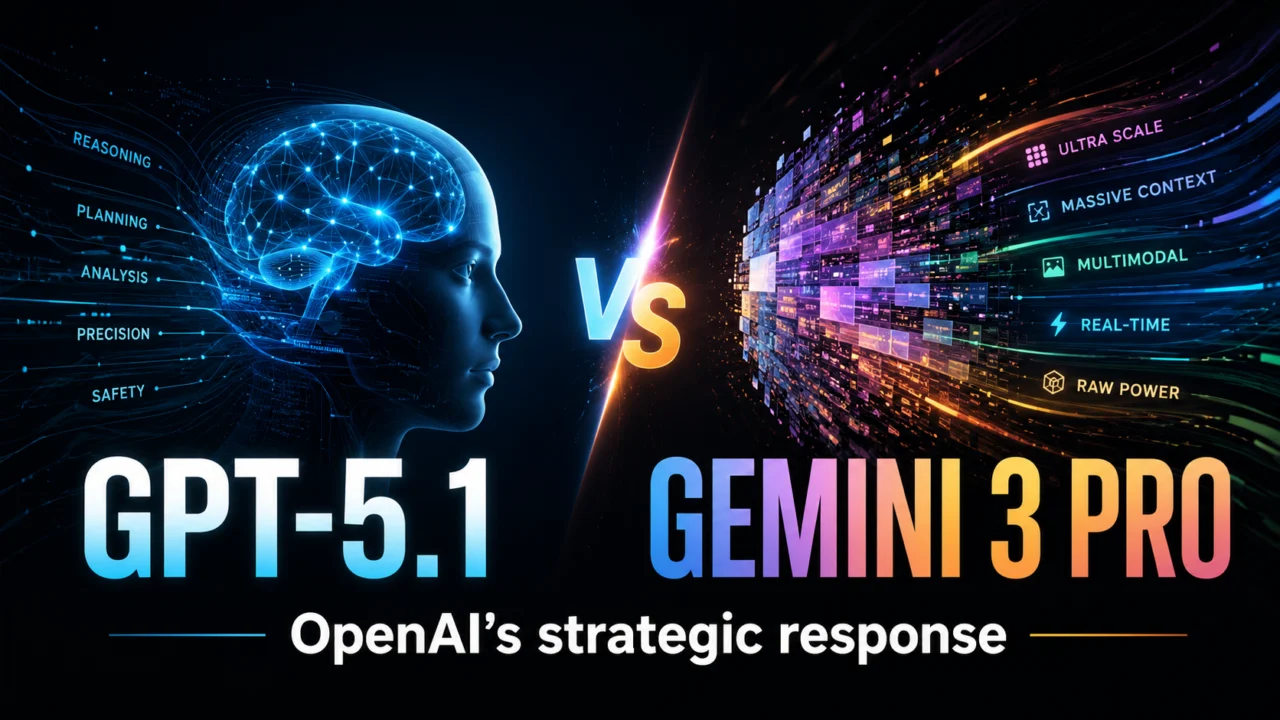
The generative AI landscape stands on the brink of a major shift. While attention focused on Google’s anticipated Gemini 3.0 Pro launch, GPT-5.1 leaks have disrupted expectations. This new OpenAI model represents more than a simple technical update. It introduces a radically different philosophy: less velocity, more reflection.
This revelation emerges within intensified competitive dynamics. On one side, Google deploys a strategy centered on brute power and massive context windows. On the other, OpenAI appears determined to create an AI reasoning like a human expert. Two visions clash. Two approaches addressing distinct professional requirements.
“This methodical approach represents a fundamental shift in language model design. Rather than optimizing solely for speed, OpenAI seems intent on creating AI capable of deep reasoning, similar to how an expert decomposes complex problems.” — Jérôme HENRY, AI Consultant – Demystia
GPT-5.1 “Thinking”: an AI that takes time to reflect
Unlike previous versions generating instantaneous responses, GPT-5.1 “Thinking” would adopt a sequential processing method. The model would analyze each query by decomposing complex elements before formulating a structured response.
Reasoning divided into clear stages
According to technical leaks, the process would function as follows:
First, the model would decompose the posed question by identifying nested sub-problems. Next, it would evaluate conversational context to maintain coherence with previous exchanges. Then, it would progressively construct its response while validating each logical step. Finally, it would perform internal verification before presenting the final result.
This approach draws inspiration from recent work on “chain-of-thought prompting”, a technique significantly improving response accuracy on complex tasks. Preliminary benchmarks suggest a 40% reduction in reasoning errors compared to GPT-4.
Enhanced contextual management
One weakness of current models lies in their difficulty maintaining coherence across lengthy conversations. After several exchanges, AI often loses thread and repeats previously provided information.
Consequently, GPT-5.1 would integrate an advanced conversational memory system. The model would retain not only mentioned facts, but also implicit preferences and emotional discussion context. This functionality recalls ChatGPT’s Memory function, but elevated to a superior level.
Indeed, the system could identify contradictory information and request clarifications rather than formulating approximate responses. This methodological caution represents a major shift in AI assistant design.
Google Gemini 3 Pro vs GPT-5.1: two opposing philosophies
While OpenAI develops GPT-5.1, Google prepares Gemini 3 Pro with a radically different strategy. This opposition reveals two distinct artificial intelligence visions.
Comparative approach table
| Criterion | GPT-5.1 “Thinking” | Gemini 3 Pro |
|---|---|---|
| Philosophy | Deep reasoning | Raw computational power |
| Context window | Optimized tracking quality | 2 million tokens |
| Response time | 5-8 seconds (complex analysis) | 2-3 seconds (massive volume) |
| Error rate | Reduced by 40% (leaked) | Current standard |
Google’s strategy: ingesting more information
Gemini 3 Pro relies on a colossal context window potentially reaching 2 million tokens. This capacity would enable processing entire documents, massive code bases, or complete projects in a single session.
However, this approach prioritizes information quantity ingested rather than analysis depth. The model excels at parallel processing of multiple sources, but doesn’t necessarily guarantee nuanced understanding of each element.
OpenAI’s approach: thinking before responding
Conversely, GPT-5.1 concentrates on reasoning quality. The model would take several additional seconds to analyze each element before responding. This voluntary latency would reduce hallucinations and logical errors.
Furthermore, this method proves particularly effective for tasks requiring cross-verification. Initial tests suggest GPT-5.1 excels at identifying internal contradictions or factual inconsistencies.
“These two approaches aren’t necessarily contradictory. They address different needs: Gemini 3 Pro will excel at processing large information volumes, while GPT-5.1 will distinguish itself on tasks requiring complex and nuanced reasoning.” — Jérôme HENRY, AI Consultant – Demystia
Thus, we’re witnessing AI market bifurcation. On one side, “bulldozer” models ingesting immense data volumes. On the other, “architect” models methodically constructing their reasoning.
Concrete professional applications of GPT-5.1
This new AI generation opens tangible prospects for businesses, particularly SMEs seeking to optimize decision-making processes.
Strategic analysis and decision-making
Professionals confronting complex choices could utilize GPT-5.1 to:
First, analyze financial reports by cross-referencing performance indicators with sectoral trends. Second, evaluate commercial opportunities by systematically identifying hidden risks and potential synergies. Third, structure sales arguments by anticipating probable client objections.
For instance, a consultant submitting a client specification sheet would receive methodical analysis decomposing technical, budgetary, and temporal constraints. The model would identify potential conflict zones between contradictory requirements.
Software development and advanced debugging
For developers, GPT-5.1 could revolutionize debugging by adopting a systematic approach:
First, the model would analyze complete problematic code context by tracing component dependencies. Next, it would identify root causes rather than superficial symptoms. Then, it would propose structured corrections with detailed reasoning explanation.
This methodical approach would considerably reduce time spent resolving complex bugs involving multiple abstraction layers. Estimates suggest a 35% productivity gain on debugging.
Technical writing and content creation
Content creators would benefit from AI capable of:
Notably, maintaining argumentative coherence across documents exceeding 10,000 words. Moreover, structuring complex reasoning with explicit logical transitions. Additionally, dynamically adapting tone and style according to overall document context.
In essence, GPT-5.1 would act as a genuine editorial assistant, capable of suggesting improvements coherent with complete text architecture.
Release date and GPT-5.1 availability
Currently, no official date has been communicated by OpenAI regarding GPT-5.1 launch. Nevertheless, several indicators suggest progressive deployment in coming months.
Probable deployment strategy
According to leaks and OpenAI’s history, the model would likely follow this chronology:
First, an alpha phase reserved for researchers and strategic partners to validate actual performance. Next, beta opening to ChatGPT Plus and Team subscribers, enabling field feedback collection. Finally, general deployment for all users, with differentiated functionalities according to subscription levels.
It remains however uncertain whether GPT-5.1 will completely replace GPT-5 or constitute an optional “expert” mode, activatable according to required task type.
Anticipated pricing and subscription options
Given the model’s increased computational complexity, several pricing scenarios are conceivable:
First, integration into the current ChatGPT subscription with monthly usage limitations. Second, a new premium tier specific to GPT-5.1, potentially priced between $25 and $40 monthly. Third, per-query billing for enterprises using OpenAI API.
Consequently, SMEs must evaluate return on investment based on their specific use cases. If your activity requires regular in-depth analyses, potential additional cost will be quickly amortized through costly error reduction.
Limitations and caution regarding leaked information
Despite enthusiasm generated by these revelations, one should remain cautious concerning currently circulating unofficial information.
What we don’t yet know
Several technical aspects remain unclear:
Notably, actual performances measured on standardized benchmarks haven’t been officially published. Moreover, exact latency for complex queries likely varies according to server load. Additionally, compatibility with existing systems via API remains to be confirmed. Furthermore, the model’s ecological impact in terms of energy consumption hasn’t been evaluated.
Also, leaks don’t specify whether GPT-5.1 will retain all GPT-4’s multimodal capabilities (image processing, code generation, audio analysis) or focus exclusively on textual reasoning.
Systematically verify official sources
Before planning professional integration, systematically consult:
First, the official OpenAI blog for verified announcements and validated technical specifications. Second, developer community feedback once the model enters public beta phase. Third, independent evaluations conducted by AI research organizations.
Indeed, recent generative AI history shows leaks sometimes prove inaccurate or partial. The 2023 GPT-4 leak notably overestimated certain model capabilities.
GPT-5.1 and the future of enterprise AI
This evolution toward models prioritizing structured reflection marks a turning point in professional generative AI usage.
Beyond speed: precision’s value
For years, the AI race concentrated on two main metrics: generation speed and processed data volume. GPT-5.1 introduces a third axis: reasoning quality.
This orientation responds to growing professional demand who, beyond time savings, seek tools capable of:
First, reducing costly errors in strategic analyses engaging company future. Second, improving automated recommendation reliability by explicitly tracing logical progression. Third, facilitating expert human validation of outputs through increased process transparency.
Consequently, we might witness clear market segmentation: fast AI for standardized repetitive tasks, reflective AI for critical decisions requiring validation.
Concrete implications for SMEs
Small and medium enterprises, often limited in specialized human resources, will derive particular advantage from these “expert” AIs. Rather than recruiting a senior analyst full-time (annual cost of $60,000 to $80,000), an SME could rely on GPT-5.1 to:
Notably, evaluate market opportunities by cross-referencing sectoral data and internal capabilities. Also, structure responses to complex tender offers by identifying discriminating criteria. Furthermore, analyze legal contracts with automatic identification of critical clauses requiring attention.
However, this expertise democratization doesn’t exempt from systematic human validation. AI remains a decision-making assistant, not an autonomous decision-maker replacing entrepreneurial judgment.
Preparing your business for GPT-5.1’s arrival
Awaiting official release, several concrete actions can be undertaken to maximize this technology’s future benefits.
Audit your current decision-making processes
Identify tasks that would most benefit from AI-assisted deep reasoning:
First, map your workflows involving complex decisions with multiple interdependent variables. Second, evaluate actual error cost in these processes (client losses, product withdrawals, legal disputes). Third, estimate potential time saved with precise AI assistance reducing iterations.
This preliminary analysis will enable prioritizing use cases during effective model deployment.
Train your teams in advanced prompting
GPT-5.1, with its structured reasoning mode, will likely require adapted prompting techniques. Consequently, develop your collaborators’ skills now in:
First, methodical decomposition of complex problems into tractable sub-questions. Next, formulation of precise and exhaustive contexts to effectively guide AI. Then, systematic critical validation of generated outputs before decision-making use.
Demystia offers personalized AI training programs to accompany this skills development within your organization.
Test current reasoning models
Before GPT-5.1’s arrival, familiarize yourself with models already prioritizing precision:
Notably, GPT-4 with explicit Chain of Thought prompts structuring step-by-step reasoning. Also, Anthropic’s Claude 3.5 Sonnet, recognized for precision on complex analytical tasks. Furthermore, specialized tools like Perplexity Pro for in-depth research with verifiable citations.
These experiments will enable identifying current limitations and concretely anticipating GPT-5.1’s differential contribution in your processes.